- sales@biolabmarket.com
- +1 (469) 819-5592

Spray Dryer Working Principle
Spray Dryer Working Principle is essential to understand how liquids, suspensions, or emulsions are efficiently converted into dry powders. Spray dryers are widely used in food, pharmaceutical, chemical, and materials industries because they combine rapid drying with high product quality. The basic principle involves atomizing a liquid feed into fine droplets and exposing them to hot air, which evaporates the solvent almost instantly. This method produces uniform, free-flowing powders with controlled particle size, moisture content, and physical properties. For small-scale experiments or initial testing, a lab spray dryer is commonly used to optimize operating parameters before scaling up to industrial production.
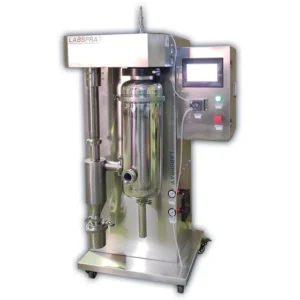
Fundamental Principle of Spray Drying
The basic concept of a spray dryer is the conversion of liquid into dry particles. The process relies on rapid evaporation of water or another solvent from fine droplets in a stream of hot air. Initially, the liquid is atomized into small droplets, which then come into contact with heated air. The moisture evaporates almost instantly, leaving behind dry solid particles that are collected as powder.
Key advantages of spray drying include:
- Extremely fast drying speeds.
- Controlled and uniform particle size in the final product.
- Suitable for materials sensitive to direct heat.
Main Components of a Spray Dryer
A typical spray dryer consists of several critical components that ensure efficient drying:
Feed System: The liquid material is supplied to the dryer via pumps or gravity-fed systems. The feed must be consistent in viscosity and solids content for uniform atomization.
Atomizer: The atomizer is responsible for converting the feed into fine droplets. There are several types of atomizers:
- Rotary atomizers, which spin the liquid at high speed to produce droplets.
- Pressure nozzles, which force liquid through a small orifice under high pressure.
- Two-fluid nozzles, which use compressed air to break the liquid into tiny droplets.
The droplet size directly affects drying rate and final powder characteristics.
Drying Chamber: The heart of the spray dryer, where atomized droplets meet hot air. Air temperature and flow patterns are carefully controlled to achieve rapid moisture removal without overheating the product.
Hot Air Supply: Hot air is usually introduced either co-currently (same direction as the droplets) or counter-currently (opposite direction). The choice affects particle residence time, drying efficiency, and heat-sensitive product quality.
Powder Collection System: After drying, particles are separated from the exhaust air using cyclones, bag filters, or electrostatic precipitators. Proper collection ensures minimal product loss and a clean exhaust stream.
Exhaust System: The remaining air, now carrying evaporated moisture, exits through an exhaust system. It may pass through filters or scrubbers before release to ensure environmental compliance.
Mechanism of Spray Drying
The spray drying process can be divided into several stages:
- Atomization: The liquid feed is transformed into small droplets. Atomization increases the surface area, allowing faster evaporation. Droplet size typically ranges from 10 to 200 micrometers.
- Initial Moisture Evaporation: When the droplets enter the hot air, the surface moisture quickly evaporates. This forms a thin dry layer on the droplet surface, creating a particle shell.
- Particle Drying: As the shell forms, moisture from the interior diffuses to the surface and continues evaporating. The drying rate depends on droplet size, air temperature, humidity, and airflow pattern.
- Powder Formation and Separation: Once the droplet is completely dry, it falls or is carried to the collection system. The final powder may have controlled particle size, density, and morphology, suitable for storage or further processing.
Process Parameters Affecting Spray Drying
Several parameters influence spray dryer performance:
- Inlet and Outlet Air Temperatures: High temperatures accelerate drying but can damage sensitive materials.
- Feed Rate: Too high a feed can lead to incomplete drying; too low wastes energy.
- Atomizer Speed or Pressure: Determines droplet size, which affects drying time and powder characteristics.
- Airflow Pattern: Co-current flow minimizes exposure to heat, while counter-current flow increases thermal efficiency.
- Solids Content: Higher solids require longer drying time but reduce overall moisture removal energy.
Applications of Spray Dryers
Spray drying is widely used across industries due to its versatility:
- Food Industry: Milk powder, coffee, egg powder, flavorings, and starch.
- Pharmaceuticals: Antibiotics, vaccines, enzymes, and active pharmaceutical ingredients (APIs).
- Chemicals: Detergents, catalysts, polymers, and pigments.
- Material Science: Ceramic powders, metal oxides, and nanomaterials.
Advantages of Spray Drying
- Rapid and continuous drying process.
- Produces fine, free-flowing powders with uniform particle size.
- Preserves heat-sensitive components due to short residence time.
- Allows precise control over powder properties like solubility and density.
Conclusion
Spray dryers are a cornerstone of modern industrial drying technology. By efficiently converting liquids into dry powders, they enable consistent product quality and process scalability. Understanding the working principle—from atomization to powder collection—is essential for optimizing performance and producing high-quality powders across multiple industries.