- sales@biolabmarket.com
- +1 (469) 819-5592

Laboratory freeze dryer
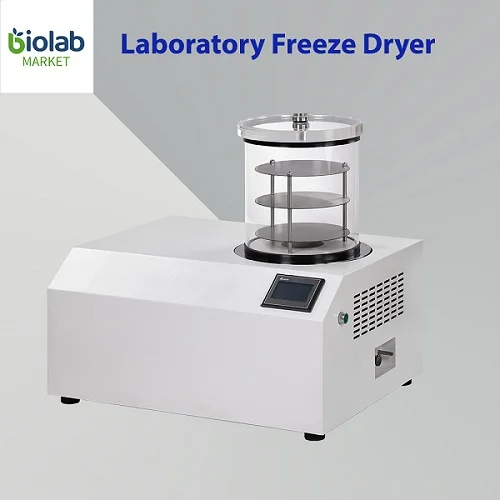
Laboratory freeze dryer — discover our cutting-edge system, a vital tool for pharmaceutical, biotechnology, and academic applications.This advanced lyophilization system enables the gentle drying of heat-sensitive materials, preserving biological activity and structure while producing high-quality powders for R&D and production scaling.
This laboratory freeze dryer operates based on the lyophilization process, enabling efficient moisture removal under vacuum conditions.
Key Features of laboratory freeze dryer
- Superior Preservation: Advanced freeze-drying technology maintains the integrity of proteins, vaccines, and biologics.
- Scalable Capacity: Ideal for lab-scale batches, with options for pilot and small production runs.
- GMP-Compliant: Engineered to meet stringent pharmaceutical and biotech standards for reliability and safety.
- User-Friendly Interface: Touchscreen controls with real-time monitoring for effortless operation.
- Energy Efficient: Optimized vacuum and temperature controls reduce energy consumption without compromising performance.
- Comprehensive Support: Full technical assistance, validation services, and training included.
general specifications of laboratory freeze dryer
- Shelf Area: 0.1–1 m² (configurable for small to medium batches)
- Condenser Capacity: Up to 3–6 kg of ice (depending on model)
- Temperature Range: Shelf: -50°C to +70°C; Condenser: -80°C to -50°C
- Vacuum Level: Down to 10 Pa for efficient sublimation
- Shelves: 2–4 heated shelves with uniform temperature distribution
- Material Construction: Stainless steel (316L) chambers and components for corrosion resistance
- Power Supply: 220–240 V, 50/60 Hz, single or three-phase options
- Dimensions: Compact footprint (approx. 80 cm W x 60 cm D x 120 cm H)
- Control System: PLC-based with data logging and recipe programming
- Safety Features: Leak detection, overpressure protection, and automatic defrost cycle
- Optional Accessories: Manifold system, vial adaptors, and CIP (Clean-in-Place) modules
Applications of Laboratory Freeze Dryers
Laboratory freeze dryers are employed in a variety of fields, each with specific needs for moisture removal and sample preservation. Some of the most prominent applications include:
1. Pharmaceuticals and Biotechnology
In the pharmaceutical and biotechnology industries, freeze drying plays a crucial role in the production of stable, long-lasting drugs and vaccines. Many biologics, such as proteins, antibodies, and enzymes, are highly sensitive to temperature and can degrade if stored improperly. Freeze-drying these substances preserves their biological activity, ensuring that they remain effective when reconstituted.
Vaccines, for example, often require freeze drying to maintain their potency during storage and transport. Freeze-dried formulations are particularly useful for vaccines that need to be shipped to remote areas without refrigeration. Additionally, lyophilization is frequently used in the production of injectable drugs, particularly those that are heat-sensitive or prone to oxidation.
2. Food Preservation
The food industry uses laboratory freeze dryers to produce freeze-dried foods, which retain most of the nutrients, flavors, and textures of fresh food. Freeze-dried foods are lightweight, easy to store, and have an extended shelf life compared to conventional dried foods. Popular products such as freeze-dried fruits, vegetables, and coffee rely on this technology.
The advantage of freeze-dried foods lies in the preservation of their original taste and nutritional content. The freeze-drying process removes water without altering the chemical structure of the food, meaning vitamins, minerals, and other important nutrients are retained. This is especially important for survival rations, emergency preparedness kits, and long-term storage applications where food needs to remain edible and nutritious for extended periods.
3. Materials Science
Freeze-drying is also used in materials science, particularly for the preservation and analysis of delicate materials. For example, in the study of polymers and advanced materials, freeze-drying is employed to remove solvents from samples without compromising their microstructure. Similarly, it is used to preserve and prepare materials for imaging or analysis under electron microscopes, where the removal of moisture is crucial to maintaining the sample’s integrity.
Freeze-drying is also important in the preparation of some types of ceramics, advanced composites, and aerogels, where the removal of water content is necessary to prevent cracks and distortion during drying.
4. Environmental Science and Research
In environmental science, freeze-drying is a valuable technique for preserving samples of soil, plant matter, and microorganisms for further study. By preserving biological samples in a near-natural state, freeze-drying allows researchers to study the effects of environmental changes or contamination without altering the composition of the samples.
Similarly, freeze-drying can be used in the preservation of biological materials from remote or extreme environments, such as the Arctic or Antarctic. These samples can be analyzed later without the risk of degradation due to moisture exposure or temperature fluctuations.
Advantages of Freeze Drying in the Laboratory
The main advantage of using a laboratory freeze dryer is its ability to preserve the structural integrity and bioactivity of sensitive samples. Some specific benefits of freeze-drying include:
Retention of Chemical and Structural Integrity: Unlike conventional drying methods, such as air or oven drying, which can cause heat-induced damage to sensitive materials, freeze-drying avoids high temperatures that might degrade proteins, nucleic acids, or other delicate substances.
Long-Term Stability: Freeze-dried materials are less likely to degrade or spoil over time. The absence of water prevents microbial growth, oxidation, and other forms of degradation, allowing products to remain stable and viable for years if stored properly.
Easy Reconstitution: Freeze-dried materials can often be rehydrated easily with the addition of water, returning them to their original state or a form that is suitable for analysis or use in further research.
Minimal Space Requirements: The absence of water in freeze-dried products makes them much lighter and smaller than their original form, which is particularly beneficial for storage, transportation, and handling.
Challenges and Considerations in Freeze Drying
Despite the numerous advantages, the freeze-drying process does come with some challenges. These include:
Cost and Time Consumption: Freeze drying is typically a more expensive and time-consuming process compared to other drying methods. The equipment and energy required to maintain low temperatures and vacuum conditions can be costly, and the process itself takes longer than traditional drying.
Potential Sample Deformation: Although freeze-drying preserves the structure of many materials, some samples may undergo minor deformation during the process. This is particularly true for materials with intricate or fragile structures, where sublimation may cause slight alterations to the original form.
Complexity of Process Control: Successful freeze-drying requires careful control of temperature, pressure, and time. Variations in any of these parameters can lead to incomplete drying, sample degradation, or inconsistent results.
Future of Laboratory Freeze Dryers
Advancements in technology are likely to continue improving the efficiency, cost-effectiveness, and precision of laboratory freeze dryers. Innovations such as improved vacuum systems, advanced sensors, and real-time monitoring tools are making it easier to optimize the freeze-drying process, reducing the time and energy required. Additionally, newer materials and systems designed to enhance the uniformity and control of freezing and drying processes are being developed to further expand the potential applications of freeze-drying technology.
Laboratory Freeze Dryer Price
The price of a laboratory freeze dryer depends on several key factors, including drying capacity, temperature range, vacuum performance, level of automation, and overall build quality. Entry-level laboratory freeze dryers designed for basic research and small sample volumes are generally more affordable, while advanced models with programmable controls, larger condensers, and precise temperature regulation are priced higher. Additional features such as touchscreen interfaces, data logging, and compliance with laboratory standards can also influence the final cost.
In addition, brand reputation, country of manufacture, and after-sales support play an important role in determining the price of a laboratory freeze dryer. Systems intended for pharmaceutical, biotechnology, or pilot-scale research applications typically require higher accuracy and reliability, which is reflected in their pricing. Choosing the right model should be based not only on price, but also on performance, long-term usability, and the specific requirements of the laboratory.
To get the price, please call the number below.
Conclusion
Laboratory freeze dryers are invaluable tools that allow scientists, researchers, and industries to preserve sensitive materials with minimal loss of quality or functionality. Whether it’s the preservation of pharmaceuticals, food products, or delicate biological samples, the ability to remove moisture without causing thermal degradation ensures the longevity and efficacy of the materials. As technology advances, the applications and capabilities of freeze dryers will likely expand, leading to even more innovative uses across diverse fields.
Frequently Asked Questions
+
What is the use of a freeze dryer in a laboratory?
A freeze dryer is used in laboratories to remove moisture from samples while preserving their structure, stability, and biological activity. It is widely applied in pharmaceutical research, biotechnology, food analysis, and material science to ensure long-term sample preservation and accurate experimental results.
+
How much does a lab freeze dryer cost?
The cost of a laboratory freeze dryer varies based on capacity, temperature range, vacuum system quality, and control features. Entry-level benchtop models are more affordable, while advanced research-grade systems are priced higher. For exact pricing, please contact Biolab Market at +1 (469) 819-5592.