- sales@biolabmarket.com
- +1 (469) 819-5592

Laboratory Spray Dryer
2-Liter Laboratory Spray Dryer for Cutting-Edge Research
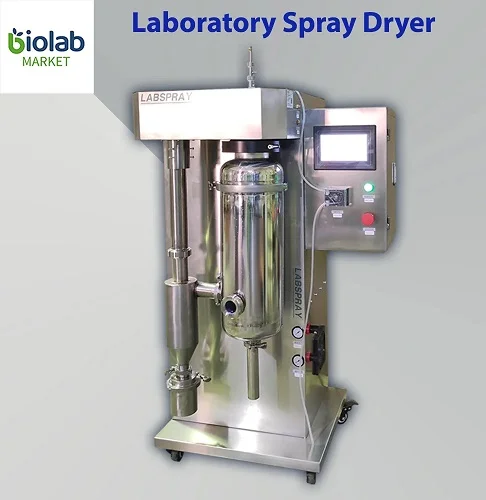
Laboratory Spray Dryer elevates your research with its advanced 2-liter design, engineered for precision and reliability in pharmaceutical, biotechnology, and academic applications. This compact system efficiently produces high-quality powders from heat-sensitive materials, making it an essential tool for innovative R&D.
Key Features Laboratory Spray Dryer
- Superior Precision: Precise temperature and airflow control ensure uniform particle size and optimal material preservation.
- 2-Liter Capacity: Perfect for small-scale experiments and pilot studies in lab environments.
- GMP-Compliant Design: Meets rigorous standards for pharmaceutical and biotech applications.
- Versatile Performance: Ideal for a wide range of uses, from drug formulation to nanotechnology and food science.
- Compact and User-Friendly: Space-saving design with intuitive controls, tailored for research labs.
- Dedicated Support: Comprehensive technical assistance and training for seamless operation.
General Specifications
- Evaporation Capacity: Up to 2 liters/hour (water-based solutions)
- Temperature Range: Inlet: 50°C to 250°C; Outlet: 30°C to 120°C
- Nozzle System: Two-fluid nozzle with customizable options for precise atomization
- Particle Size Range: 1–50 µm, adjustable for specific applications
- Material Construction: Stainless steel (316L) for GMP-compliant components
- Power Supply: 220–240 V, 50/60 Hz, single-phase
- Dimensions: Compact design (approx. 120 cm H x 80 cm W x 60 cm D)
- Control System: PLC-based touchscreen interface for real-time monitoring
- Safety Features: Overheat protection, emergency stop, and pressure regulation
- Optional Accessories: Cyclone separator, HEPA filter, and data logging system
Applications of Laboratory Spray Dryers
A laboratory spray dryer is essential for producing stable, uniform powders in:
• Pharmaceutical and biotechnology research
• Food and dairy product development
• Herbal extracts and nutraceuticals
• Encapsulation of flavors and sensitive compounds
• Production of probiotics and micro-organisms
• Cosmetic powders and pigments
• Chemical, polymer, and material science research