- sales@biolabmarket.com
- +1 (469) 819-5592

What Is the Difference Between a Spray Dryer and a Freeze Dryer?
Drying technologies are essential in modern food, pharmaceutical, chemical, and biotechnology industries. Choosing the right method can directly affect product quality, stability, and production cost. In research and product development stages, equipment such as a lab spray dryer is widely used to study how liquid formulations behave during drying before scaling up. Among the most common drying technologies, spray dryers and freeze dryers stand out due to their efficiency and versatility. Although both are designed to remove moisture and extend shelf life, they differ significantly in process principles, operating conditions, and end-product characteristics.
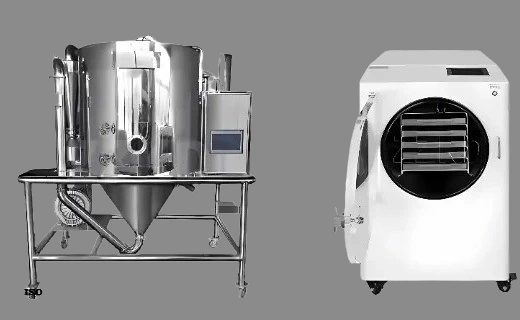
Fundamental Drying Principles
Spray Drying Technology
Spray drying is a rapid, continuous drying process. A liquid feed—such as a solution, suspension, or emulsion—is atomized into fine droplets using a nozzle or rotary atomizer. These droplets are introduced into a chamber filled with hot air. Due to the large surface area of the droplets, moisture evaporates almost instantly, leaving behind dry particles that are collected as powder.
In research and formulation development, a lab spray dryer is commonly used to evaluate drying behavior, encapsulation efficiency, particle size distribution, and powder flow properties before moving to pilot or industrial-scale systems.
Freeze Drying Technology
Freeze drying, also known as lyophilization, is a low-temperature, vacuum-based process. The product is first frozen, then placed under reduced pressure. Ice is removed through sublimation, allowing water to transition directly from solid to vapor. This process avoids thermal stress and preserves the original structure of the material.
Temperature Exposure and Heat Sensitivity
One of the most critical differences between spray drying and freeze drying is thermal exposure.
- Spray drying uses high inlet air temperatures, sometimes exceeding 150–200°C. However, the actual product temperature remains relatively low due to evaporative cooling and extremely short residence time.
- Freeze drying operates at sub-zero temperatures and low pressure, making it ideal for extremely heat-sensitive compounds.
For biological materials, live cultures, proteins, and vaccines, freeze drying offers superior protection. For many food ingredients, polymers, and pharmaceutical carriers, spray drying provides sufficient thermal protection while being far more efficient.
Impact on Product Structure and Composition
Spray-Dried Products
Spray drying produces spherical particles with controlled size and density. The resulting powders usually have:
- Good flowability
- High solubility or dispersibility
- Consistent bulk density
This makes spray drying highly suitable for instant products, encapsulated flavors, and powdered chemicals.
Freeze-Dried Products
Freeze drying creates a highly porous, sponge-like structure. This structure allows rapid rehydration and excellent retention of volatile compounds. However, freeze-dried products are often fragile and may require secondary processing if a uniform powder is needed.
Processing Speed and Throughput
Spray drying is known for its exceptionally fast processing time. Drying occurs in seconds, and industrial systems can operate continuously for extended periods. This makes spray drying ideal for high-volume production.
Freeze drying, in contrast, is a slow batch process. A single cycle may take anywhere from several hours to several days, depending on product thickness and moisture content.
Cost and Energy Considerations
From an economic standpoint, spray drying is generally more cost-effective:
- Lower energy consumption per unit of product
- Lower equipment and maintenance costs
- High scalability
Freeze drying requires:
- Vacuum pumps and refrigeration systems
- Long processing times
- High capital and operating costs
As a result, freeze drying is typically reserved for products with high added value or strict quality requirements.
Flexibility and Scalability
Spray drying systems are highly scalable. Data generated from a lab spray dryer can often be translated to pilot and industrial units with relative ease. This makes spray drying attractive for companies planning large-scale commercialization.
Freeze drying scale-up is more complex, as heat and mass transfer behave differently in larger systems. This can increase development time and cost.
Typical Industrial Applications
Applications of Spray Dryers
- Dairy powders and plant-based proteins
- Instant beverages and flavor encapsulation
- Pharmaceutical excipients and inhalation powders
- Chemical catalysts and polymers
Applications of Freeze Dryers
- Injectable drugs and vaccines
- Probiotics and biological samples
- Specialty foods with maximum nutrient retention
- Long-term preservation of sensitive materials
Conclusion
While both spray drying and freeze drying are effective moisture-removal technologies, they serve different purposes. Spray drying is fast, economical, scalable, and ideal for producing uniform powders at industrial scale. Freeze drying excels in preserving highly sensitive materials but comes with higher costs and longer processing times.
Choosing the right drying method depends on product sensitivity, desired physical properties, production volume, and budget. In many industries, both technologies are used strategically at different stages of research, development, and manufacturing to achieve optimal performance and quality.