- sales@biolabmarket.com
- +1 (469) 819-5592

Applications of Laboratory Spray Dryer in Pharmaceutical Research
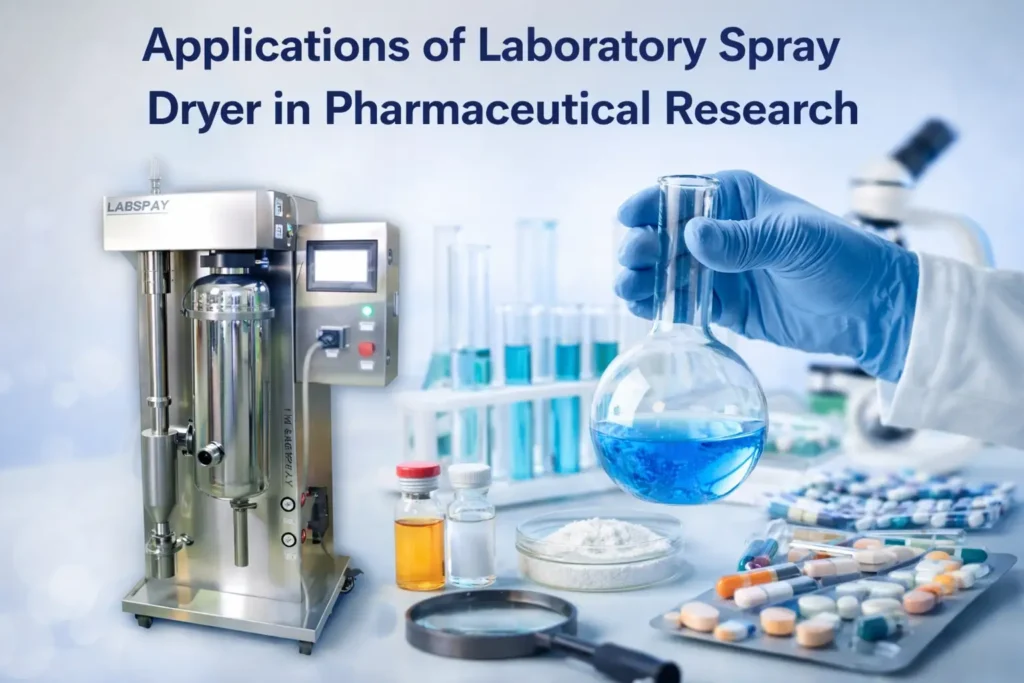
Pharmaceutical research requires highly controlled processes to ensure product quality, stability, and safety. One of the most widely used technologies in pharmaceutical R&D laboratories is spray drying. A laboratory spray dryer enables researchers to convert liquid formulations into dry, stable powders with precise control over particle properties.
Due to its flexibility and scalability, spray drying has become a critical tool in drug development, formulation optimization, and early-stage manufacturing studies.
Role of Spray Drying in Pharmaceutical Development
Spray drying is particularly valuable in pharmaceutical research because it allows rapid processing while preserving the integrity of active pharmaceutical ingredients (APIs). Using a laboratory spray dryer, researchers can evaluate different formulations, excipients, and process parameters before moving to pilot or commercial production.
This technology supports innovation by reducing development time and improving formulation performance.
Key Applications of Laboratory Spray Dryer in Pharmaceuticals
Dry Powder Inhaler (DPI) Formulation
One of the most important pharmaceutical applications of a laboratory spray dryer is the development of dry powder inhalation products. Spray drying enables the production of particles with controlled size, morphology, and density—critical factors for lung deposition and bioavailability.
Researchers use laboratory-scale spray dryers to:
- Optimize aerodynamic particle size
- Improve powder flowability
- Enhance drug delivery efficiency
Improving Solubility and Bioavailability
Many modern drug compounds suffer from poor water solubility. Spray drying allows APIs to be transformed into amorphous or solid dispersion forms, significantly enhancing dissolution rates.
A laboratory spray dryer helps researchers test different carrier materials and process conditions to maximize bioavailability while maintaining stability.
Microencapsulation of Active Ingredients
Microencapsulation is another key application in pharmaceutical research. Spray drying allows APIs to be encapsulated within protective matrices, improving:
- Chemical stability
- Controlled release behavior
- Taste masking for oral dosage forms
Laboratory spray dryers are ideal for developing and optimizing encapsulation strategies using minimal material.
Development of Oral and Parenteral Dosage Forms
Spray-dried powders are commonly used in tablets, capsules, and injectable formulations. The uniformity and reproducibility achieved with a laboratory spray dryer ensure consistent dosage and improved product performance during early-stage testing.
Advantages of Using Laboratory Spray Dryer in Pharmaceutical R&D
High Process Control
Precise adjustment of inlet temperature, feed rate, atomization pressure, and airflow allows reproducible experiments and reliable data generation.
Small-Scale Efficiency
Pharmaceutical APIs are often expensive and limited in quantity. Laboratory spray dryers enable efficient experimentation using very small batch sizes.
Seamless Scale-Up
Data generated during laboratory spray drying can be directly applied to pilot and industrial-scale systems, reducing risks during technology transfer.
Regulatory and Quality Considerations
In pharmaceutical research, compliance with quality standards is essential. Modern laboratory spray dryers are designed to support:
- GMP-aligned development workflows
- Cleanability and contamination control
- Accurate documentation of process parameters
These features help streamline the transition from research to commercial manufacturing.
Conclusion
Spray drying has become an indispensable technology in pharmaceutical research laboratories. From dry powder inhalers to bioavailability enhancement and microencapsulation, a laboratory spray dryer provides the precision, flexibility, and scalability required for modern drug development. Investing in the right laboratory spray drying equipment enables faster innovation, improved formulation quality, and smoother scale-up to production.