- sales@biolabmarket.com
- +1 (469) 819-5592

Technology & Operation of Lab Spray Dryers
Understanding the technology and operational principles behind lab spray dryers is essential for achieving consistent powder quality and reproducible results. These systems are designed to transform liquid feed into fine, dry particles through a precisely controlled thermal drying process. Below is a comprehensive overview of how the technology works and how it is optimized in laboratory environments.
Spray Drying Technology at Laboratory Scale
A lab spray dryer operates based on three core stages: atomization, drying, and particle separation.
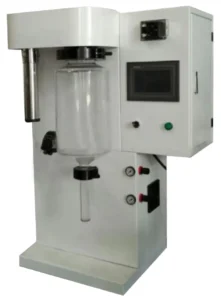
Atomization Process
The liquid feed (solution, suspension, or emulsion) is pumped into the drying chamber and atomized into fine droplets using a nozzle or rotary atomizer. The droplet size plays a critical role in determining final particle size and powder characteristics.
Key factors influencing atomization:
- Nozzle type (two-fluid, pressure, ultrasonic)
- Feed viscosity
- Pump rate
- Compressed air flow
Smaller droplets result in finer powders and faster evaporation.
Drying Chamber and Heat Transfer
Once atomized, the droplets come into contact with hot drying gas (usually air or nitrogen). Rapid solvent evaporation occurs within seconds.
Important temperature parameters:
- Inlet temperature – Controls evaporation rate
- Outlet temperature – Indicates final moisture content
- Thermal stability of material – Prevents degradation
Modern lab spray dryers allow precise temperature control, making them suitable for heat-sensitive materials such as proteins, enzymes, and pharmaceutical compounds.
Particle Collection System
After drying, particles are separated from the air stream using:
- Cyclone separators
- Collection vessels
- Optional secondary filters
Efficient particle recovery ensures minimal product loss, which is especially important in laboratory-scale experiments where material quantities are limited.
Key Operational Parameters
Optimizing operational settings is critical for achieving desired powder properties.
Feed Rate
Higher feed rates increase throughput but may result in incomplete drying if not balanced with temperature and airflow.
Airflow Rate
Controls drying efficiency and particle residence time in the chamber.
Atomization Pressure
Affects droplet size and final particle morphology.
Solvent Type
Water-based vs. organic solvents require different drying conditions and safety measures.
Process Optimization in R&D
In research and development settings, lab spray dryers are primarily used to:
- Test new formulations before pilot-scale production
- Optimize particle size distribution
- Improve solubility and bioavailability
- Study powder flowability and stability
Fine-tuning process parameters allows researchers to replicate industrial spray drying conditions on a smaller scale while minimizing cost and material usage.
Maintenance and Troubleshooting
Proper maintenance ensures consistent performance and extended equipment lifespan.
Common operational challenges:
- Nozzle clogging
- Wall deposition inside the drying chamber
- Low product recovery
- Inconsistent particle size
Routine cleaning, calibration, and inspection of seals and airflow systems help prevent these issues.
Conclusion
The technology and operation of lab spray dryers combine precision engineering with advanced thermal processing. By controlling atomization, temperature, airflow, and collection efficiency, laboratory spray drying enables the production of uniform, high-quality powders for pharmaceutical, food, chemical, and material science applications.
Mastering these operational parameters ensures reproducible results and smooth scale-up from laboratory experiments to industrial production.